
How Los Angeles Arrests Move
Los Angeles runs on two separate custody systems. The Los Angeles Police Department makes city arrests, while the Sheriff's Department handles the county jail side. That split confuses plenty of families looking for a loved one after an arrest in Los Angeles.
An LAPD arrest has no single online destination. Custody Services names three city jail facilities: Metropolitan Detention Center, 77th Street Regional Jail, and Valley Regional Jail. Someone arrested might be cited and released on the spot. Others stay in LAPD custody, get medical care first, or move into LASD county custody. Each path leaves a different record trail and its own delay.
The city itself is huge. Its official January 1, 2026 population estimate sits at 3,806,201. Arrests and bookings happen across overlapping layers: LAPD divisions, transit policing, city custody, and the county system. So a missing LASD result proves little about Los Angeles. The person may still sit in city custody, be released without county booking, or show up under another agency's arrest record.
Where Los Angeles Recent Arrests Appear
City, county, and court systems answer different questions. LAPD publishes no citywide daily arrest roster for the public. LASD tools show county custody and recent sheriff bookings. News pages pick incidents by editorial interest. Completeness is never the goal.
| Channel | What it covers | Photo status | Authority |
|---|---|---|---|
| LAPD Custody Services | City jail information and routing | No complete public gallery | Official |
| LASD Inmate Information Center | Eligible current county custody; last two hours may be unavailable | No verified public-photo guarantee | Official |
| LASD Booking Log | Station and time-range queries within seven calendar days | Not established as a photo source | Official |
| Superior Court Criminal Index | Indexed criminal cases and filing location | No booking-photo function | Official |
| Los Angeles Times Crime & Courts and ABC7 arrest coverage | Selected incidents and court stories | Story-specific images | Independent news, incomplete |
Not every news photo is a booking photo. Some are scene images, agency handouts, or file pictures from earlier stories. None of that means LAPD runs a public mugshot feed. Coverage is selective. Treat it as clues rather than a roster.
Finding Someone Arrested in Los Angeles
Begin with the arresting agency and where the person is being held. Don't just paste a name into every database. The city-jail and county-jail split demands a sequence. Work it in order and you avoid wasted searching.
- Confirm whether LAPD, LASD, or another agency made the arrest. An incident location inside city limits does not by itself identify the custodian.
- For a fresh LAPD arrest, consult LAPD jail and custody information. The person may still be held in a city facility.
- If county transfer is likely, search LASD IIC by required first and last name. Add middle name and date of birth when known, complete reCAPTCHA, and allow for its two-hour new-booking gap.
- Search the LASD Booking Log by station and date/time range. The form reaches only the rolling last seven calendar days and is not a permanent Los Angeles arrest archive.
- Use the Los Angeles Superior Court Criminal Index for a later case and disposition trail. Match identity carefully because a name alone can identify the wrong person.
The county-wide Los Angeles County recent-arrest hub digs into rosters, logs, photo policy, and custody distinctions. It's the deeper reference for this area. Keep one quirk in mind. A released person drops off a current roster. An arrest summary and a court case still exist. For a visual starting point, the official Los Angeles Superior Court Criminal Index shows how a name or case-number search opens.
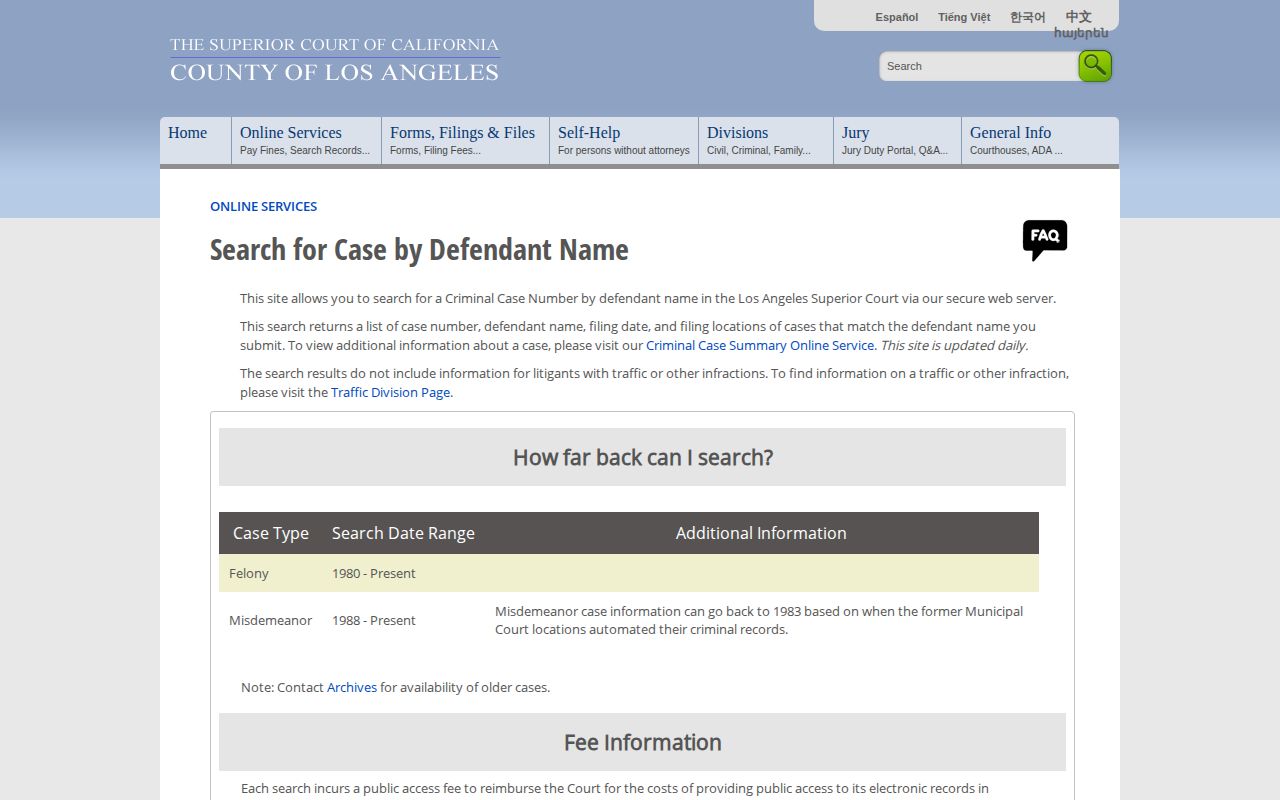
That court page is just a search entry point. It displays a form, nothing more. Typing a name there returns index entries. It is not itself an arrest record.
Three LAPD Jails, One County Interface
Three city jails make Los Angeles unusual among big cities. Metropolitan Detention Center, 77th Street Regional Jail, and Valley Regional Jail each hold arrestees. Which one takes a person depends on the arrest and city processing. Not everyone goes to county jail. If LASD accepts the person later, the Inmate Reception Center at 450 Bauchet Street joins the custody trail. The assigned facility can shift after intake.
LASD IIC is not a full LAPD arrest log. It answers one question: is an eligible person in county custody right now? The Booking Log answers a different one, whether a recent LASD booking matches chosen station and time filters. LAPD custody information covers the earlier city stage. Keep those questions separate. A roster miss is not proof of release.
The Inmate Reception Center sits within the Men's Central Jail and Twin Towers complex. LASD also uses Twin Towers Correctional Facility, Century Regional Detention Facility, North County Correctional Facility, and the Peter J. Pitchess Detention Center. Placement can change during county custody. Trust the current IIC result for today's facility listing. Do not lean on the original arrest location or any news report.
When a web search stalls, the county service locator lists 24-hour inmate information numbers: (213) 473-6100 and (213) 473-6080. Staff will not always disclose every record or photo. The call does not replace an LAPD arrest-summary request either. It's a fallback for finding where someone sits in county custody.
Note: A transfer, citation, hospital hold, or release can shift which official source holds the useful record at any moment.
LAPD Arrest Summary Requests
LAPD offers a fingerprint-based personal record route, not a public daily list. An arrest summary covers arrests made by LAPD. It may include dates, charges, and dispositions on file. Arrests by other agencies do not appear. LAPD also warns that arrest reports usually are not handed over the counter and may need a subpoena or court order.
- Use the LAPD arrest-summary instructions and prepare a request letter.
- Include a completed FD-258 fingerprint card and a copy of government identification.
- Include the listed $25 check or money order for an arrest summary, or $26 for a detention letter. Confirm the current fee before mailing.
- Mail the packet to LAPD Records and Identification Division, ATTN CSRRU-Arrest Summary or Detention Letter, P.O. Box 30158, Los Angeles, CA 90030.
Processing time varies, according to LAPD. This route promises no booking photograph. For a county-held booking record or an eligible photo, turn to LASD Records and Identification. That office sets its own release rules, which differ from LAPD's.
Los Angeles Police DepartmentRecords and Identification Division
100 W. 1st Street, Room P1-731
Los Angeles, CA 90012
213-486-8300 or 213-486-8310
Los Angeles Mugshots and Record Limits
A booking photo is taken as part of identifying a person under arrest, yet not every Los Angeles recent arrest comes with a public picture. LASD does not promise that IIC or Booking Log results include a photo. LAPD's arrest-summary route works the same way. It is not a mugshot request line. California statutes and each agency's own release rules decide what you can see.
Two laws shape this. Government Code section 7923.610 covers specified arrest details. These include booking time, arrest location, bail, where the person is held or released, and the charges, all subject to exemptions. Penal Code section 13665 covers certain nonviolent booking photographs. It limits how law enforcement can share them on social media. Neither statute requires a city or county roster to double as a photo gallery.
For the difference between official photos and formal requests, see the county hub's mugshots and booking-photo section.
City Arrest Coverage Is Selective
News outlets in Los Angeles cover arrests selectively. The Los Angeles Times Crime & Courts topic and ABC7's arrest tag report chosen LAPD incidents, investigations, filings, and court developments on a news-driven schedule. Local Crime News lists Los Angeles in its city directory too. It is an unofficial aggregator, though. Its historical counts and entries may be stale, incomplete, or mismatched. Official LAPD, LASD, and court records still control. The ABC7 Los Angeles arrest page shows how one regional outlet organizes its selected stories.

A news index helps with context. It is not an arrest list. It is not a booking-photo archive either. A story may leave out a booking number, custody status, or a later case result. Confirm the arrest with the police agency that made it, check current custody with the proper jail system, and get the case outcome from Los Angeles Superior Court.
After a Los Angeles Arrest
Booking starts the paper trail after a Los Angeles arrest. From there, a case can move through prosecutor review, arraignment, a bail or release decision, pretrial hearings, diversion, dismissal, a plea, trial, or judgment. LASD procedure materials describe an appearance by the second court day under the applicable framework. Weekends and holidays can shift that calendar. This is a processing rule only. It does not promise filing or release.
The Superior Court Criminal Index updates daily. It reaches felony cases from 1980 forward and misdemeanors generally from 1988 forward, with some earlier material. Online criminal documents stay limited. The court of record remains the stronger source for outcome papers. A no-result may reflect timing, a spelling issue, the filing location, or simply that no case was filed.
- City custody
- A person held in an LAPD jail before transfer or release.
- County custody
- An eligible person held through LASD and potentially visible in IIC.
- Booking record
- The identification and custody record created at processing.
- Disposition
- The later court outcome, which can differ from the booked charge.